The strawberry and America 250
As we continue with our celebration of America 250, we must include the Strawberry Festival in Rhea County which observes the seventy-ninth year of the event during 2026.
There is a Christmas song which opens with the words, “It’s beginning to look a lot like Christmas everywhere you go,” and those same words could be used for Rhea County by substituting the word strawberries for Christmas. At the present time, we see all types of ads, signs, flags and other items advertising the upcoming Strawberry Festival during May. Also, we all hope the weather will cooperate so that there will be a good crop, and the berries will be firm and sweet. I think most of us are ready for that delicious red berry that hypnotizes us each spring.
According to an article from the Dayton Herald, which was dated May 18, 1933, an unusually large crop of strawberries was shipped from Rhea County during that year. The article stated that continued rainfall and lack of sunshine injured the Klondike, or early berries; they did not have their usual good flavor, and were not able to stand up for shipping to distant cities. However, the newspaper did let the reader know that in the last few days (before the article was printed) Rhea County had fair weather, so that berries were again abundant in Dayton and Spring City, which were the two principal shipping points.
Also, the correspondent wrote that buyers were from Ohio, West Virginia, Kentucky, Indiana, Georgia, Louisiana, Michigan and other states.
An interesting side note was that the shipments had to be inspected by Federal officers for the first time; the writer said that this improved the quality of the berries and the packing. Before the enforcement of inspection it was not uncommon to find sticks, stones and other foreign material in the bottoms of the boxes or “cups” as they are called in this area. Also, for the first time in several years, some of the large berry growers turned to Sunday picking during the week of May 18 that year. During the early part of the week the wet weather made the early berries soft and unfit for market, with berry brokers refusing to accept those berries. This resulted in thousands of crates of berries being left in the fields. When fair weather returned, the market picked up, and growers were advised to pick the early berries. This resulted in three carload shipments going out of Dayton on Sunday night.
That same article states that a total of sixty freight cars of strawberries had left from Spring City at the beginning of the season to the date of this news story in 1933. Also, the writer tells his readers that the prices in the Northern markets were constantly dropping. However, there might be hope for the grower because the late variety, known as the Aroma, would be in during the week the Herald article was being written. It is stated that the Aroma is a much larger berry and is preferred in the Northern markets due to its superior appearance.
Also, from the writing we are told that the Aroma is served with the cap on and grouped around a mound of sugar (in the large restaurants).
Another Dayton Herald article dated June 1, 1933 states that one hundred cars of strawberries were shipped from Spring City during the season by freight, and twenty- one cars by express. Also, it was reported that more than four hundred cars were shipped from Rhea County.
During the last week of May, Rhea County growers stopped shipments to Northern markets because prices dropped so low. The lowest price was forty cents per crate, with the highest being $3.40 per crate.
There is also another note to the Rhea County Strawberry Festival. You will read about its history in another part of this newspaper and see the schedule of events there also. There was an historic cape which was made by Maude Thomison (1891-1975), daughter of Dr. Walter Fairfield Thomison and Ella Darwin Thomison, and the great-aunt of Pat Guffey.
Maude was asked by the Strawberry Festival Committee to make this cape because they wanted to add something more than a crown to the festivities when the winner was announced. Maude studied Costume Design in New York and designed and made wedding dresses, evening gowns, winter coats and other clothing items for clientele in the Rhea County area.
During the early years of the Strawberry Festival, the Queen Contest served as a qualifier for the Miss Tennessee Pageant. Throughout that celebration, this cape was placed around the newly crowned queen’s shoulders when she became the winner.
Those early festivals were known as the East Tennessee Strawberry Festival, with the previous queen crowning the new one on Saturday night of parade day.
Then in 1991, the Strawberry Festival Queen Contest ended for several reasons. The sponsors felt that the competition was keeping local girls from entering, and that the money was sponsoring a Miss Tennessee qualifier from outside Rhea County. This pageant then became the Rhea County Young Woman of the Year Scholarship Contest; shortly after that it changed once more and became the Rhea County Junior Miss Contest. At the present time it is the Distinguished Young Women Contest.
Since the cape was made of red velveteen with a thinner lining, it could not last forever!
After years of being cleaned and pressed, the cape soon was worn out. However, it made a nice contribution to the Queen Contest while it lasted.
Yes, it is beginning to look a lot like the strawberry season, even though Rhea County’s strawberry crop is not anything like it used to be in the early days. However, we will welcome the strawberry and all the festivities associated with it, because it has a vital connection to our history. As your Rhea County Historian, I remind you to study the past in order to live in the present and prepare for the future.
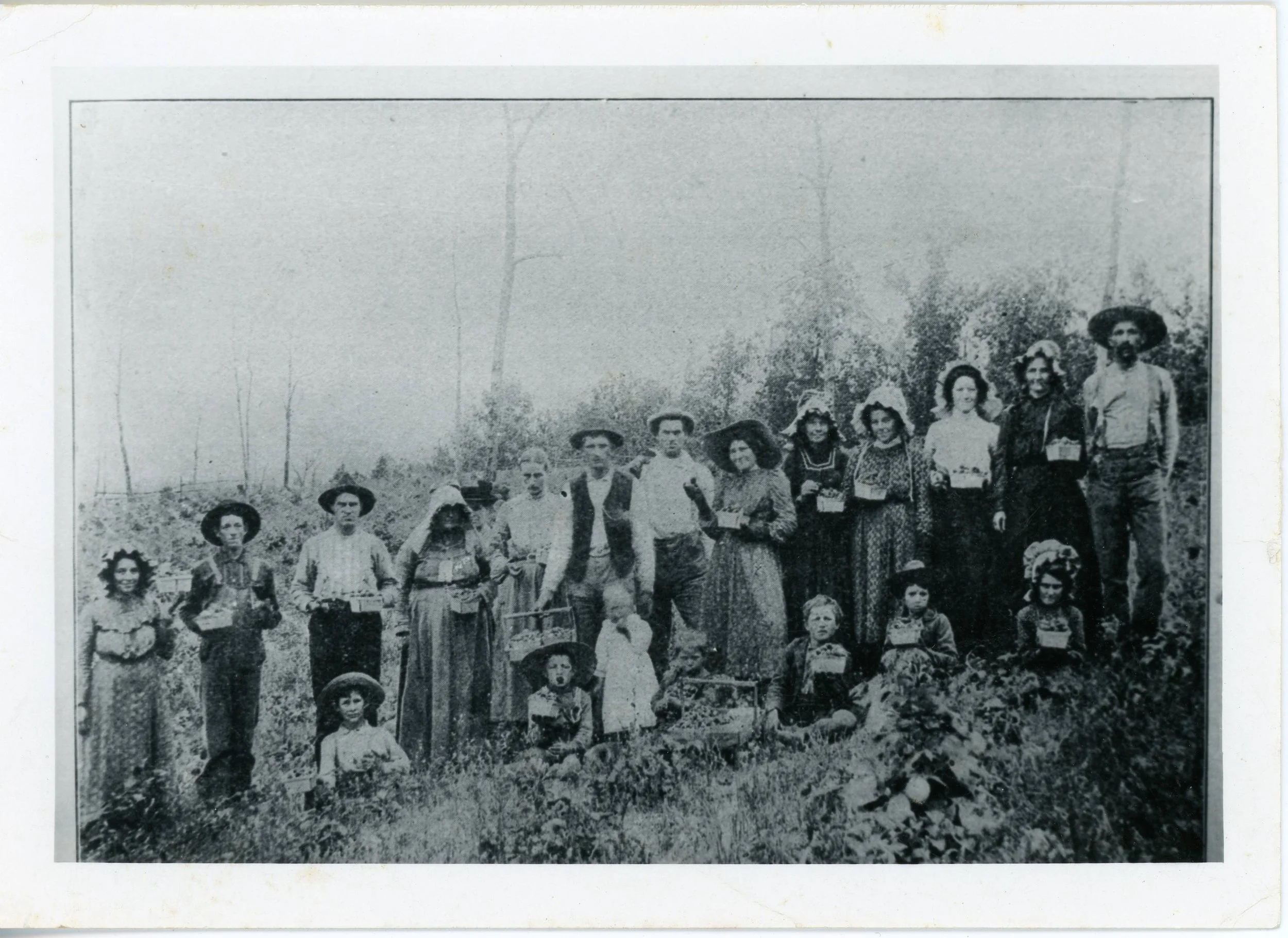
Strawberry pickers in Rhea County